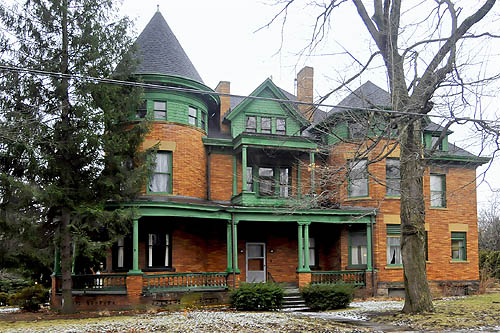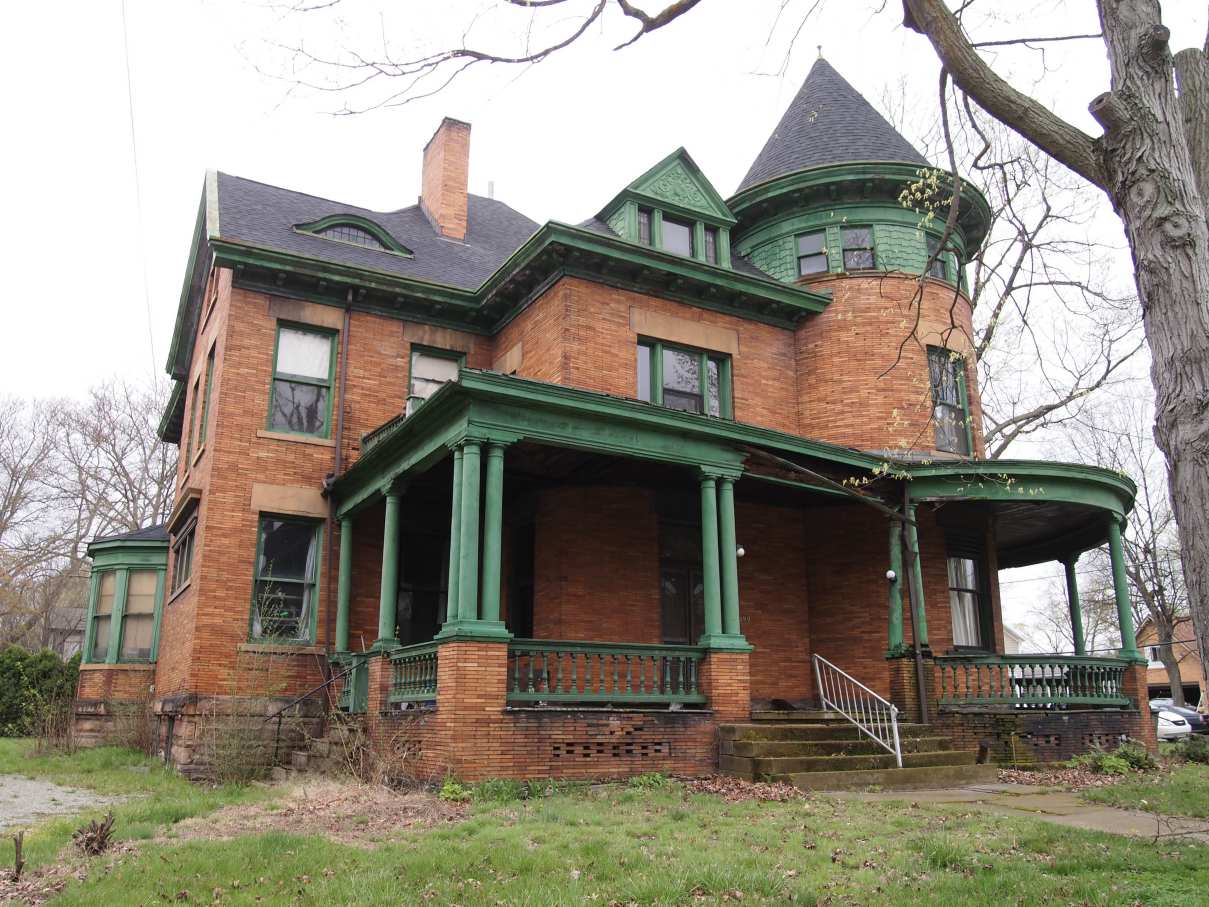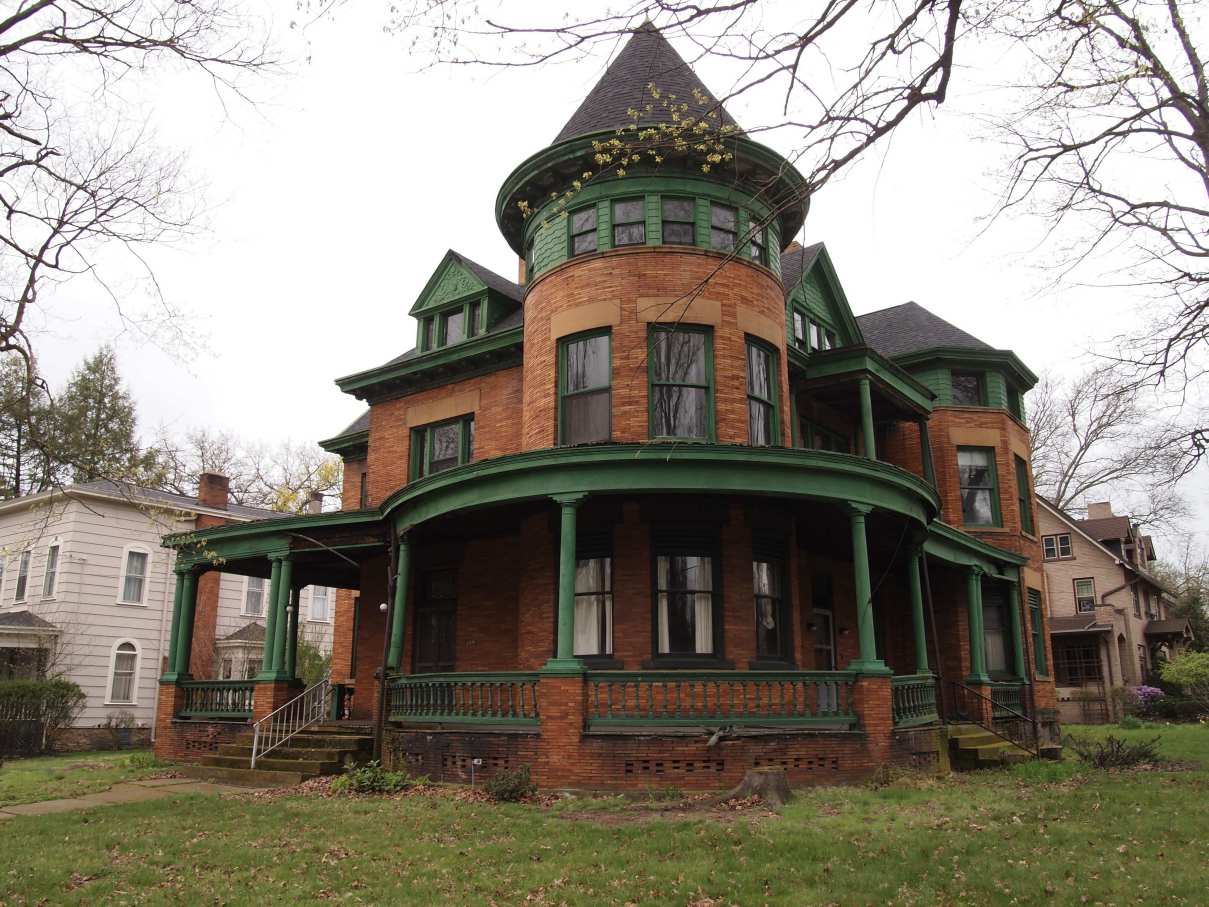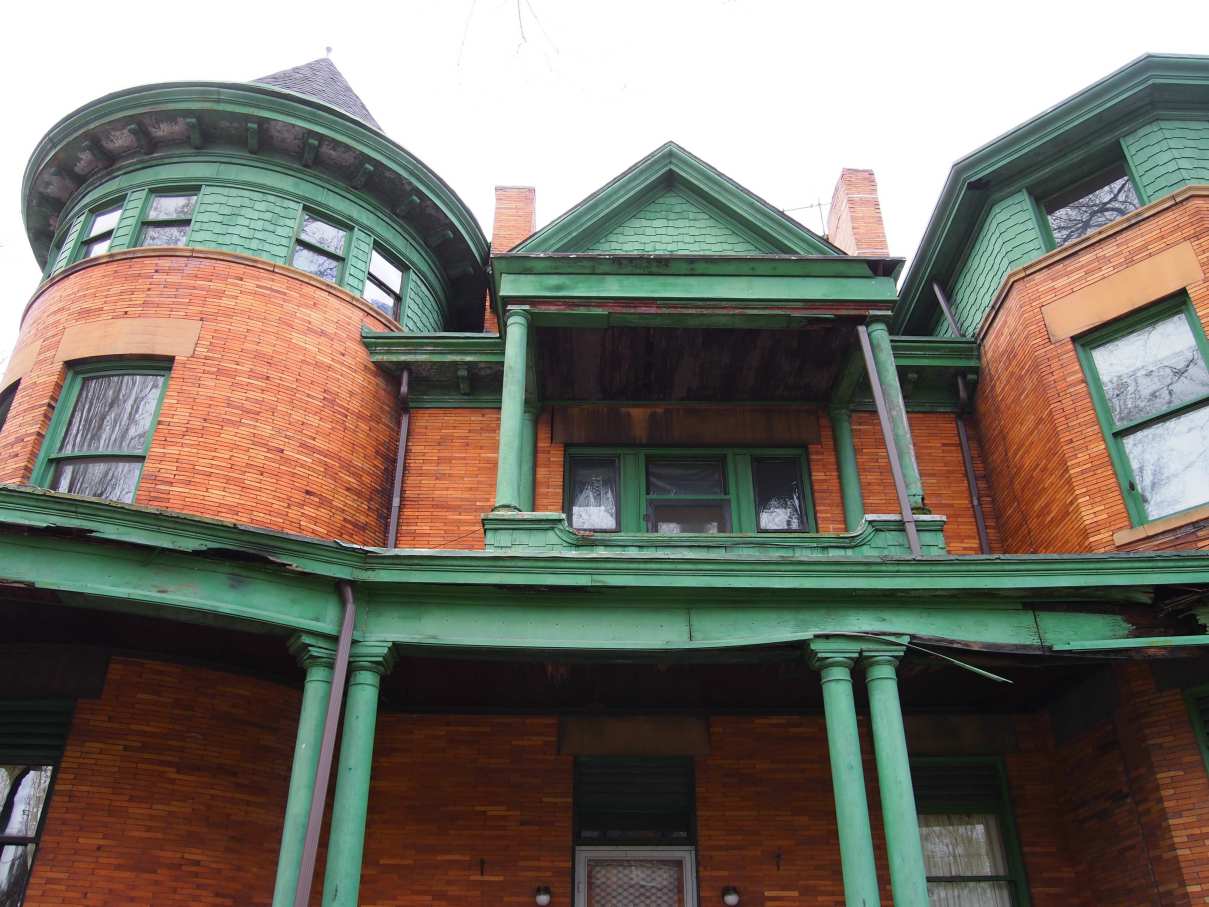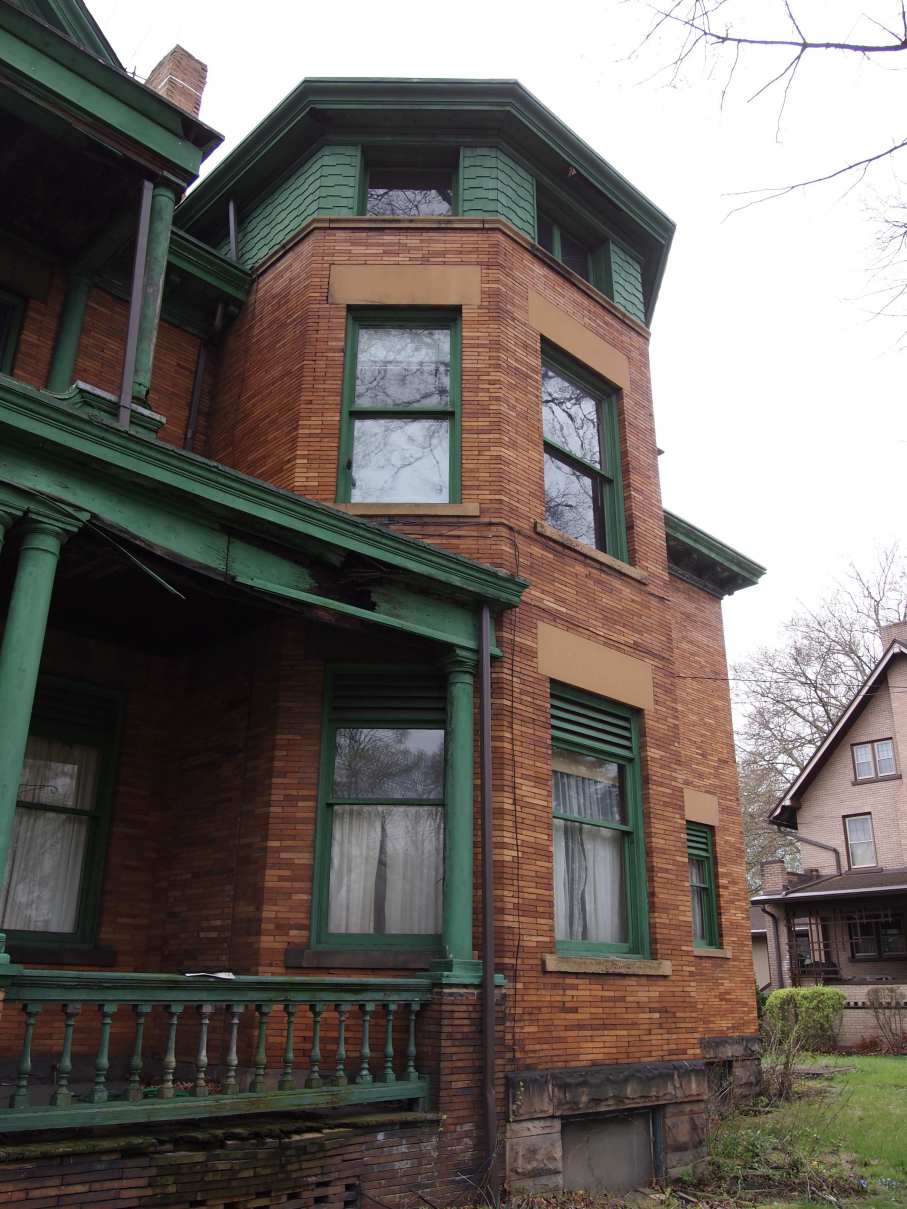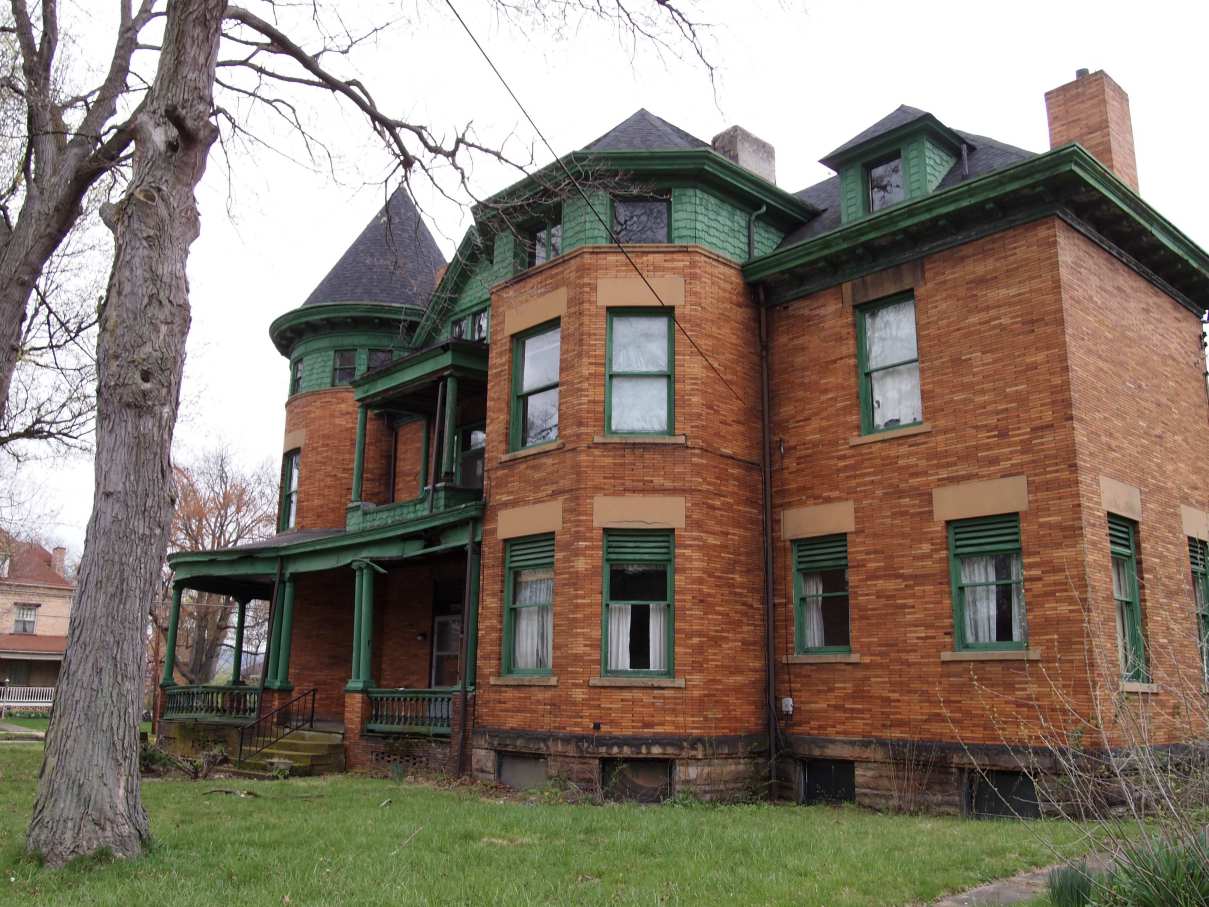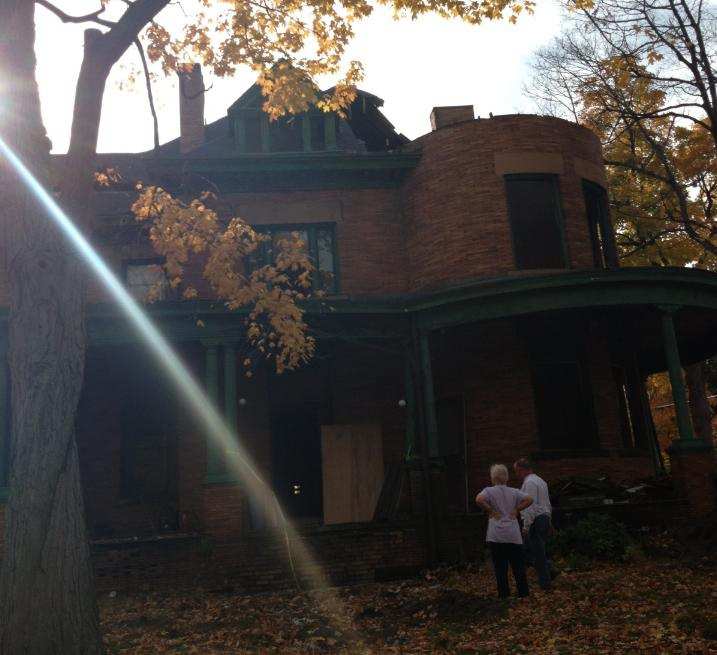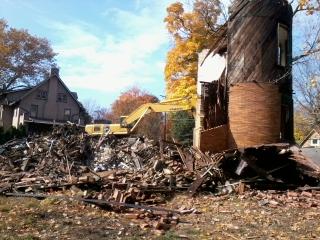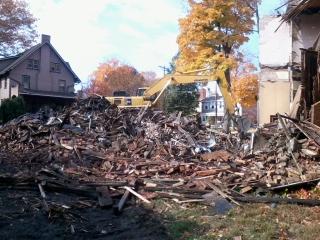
1899 Queen Anne, Beaver, PA – $129,000

Property Info
199 Beaver St, Beaver, PA 15009
Price: $169,000 $149,000 $129,000
Listing Status: Active**
Historic Register Status: --
Taxes --

Beds: 6
Bath: 4.5
Square Feet: 6000
Acres: .3

References: Zillow, Post Gazette (Pics came from here by Bob Donaldson)
Additional History:
Area Info: City Data, Wikipedia, Spot Crime
Posted on: 3/01/12
Last Updated: 3/4/12
Description from the listing:
Victorian Home! ~Location, Location, Location~~~ ~In the Heart of Beaver~ ~CORNER LOT!!~ ~1900 Grandeur~ ~Ready for Restoration~ ~So much potential!!~

Agent Info & MLS
Broker: Kathy Green, Re/Max
Office Phone: 724-933-6300
Mobile Phone:
Other Phone:

MLS# 899219

Maps

Aerial View


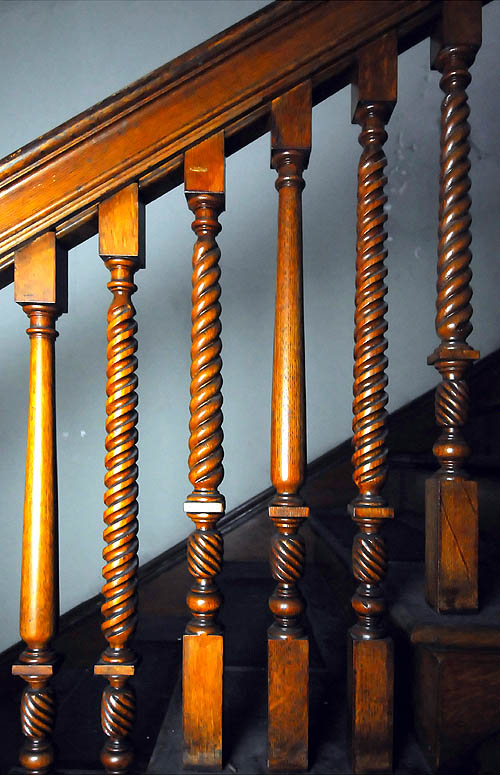
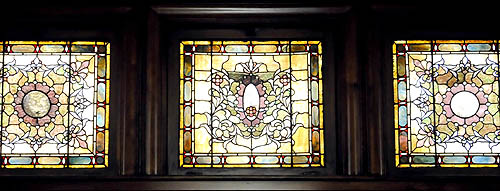
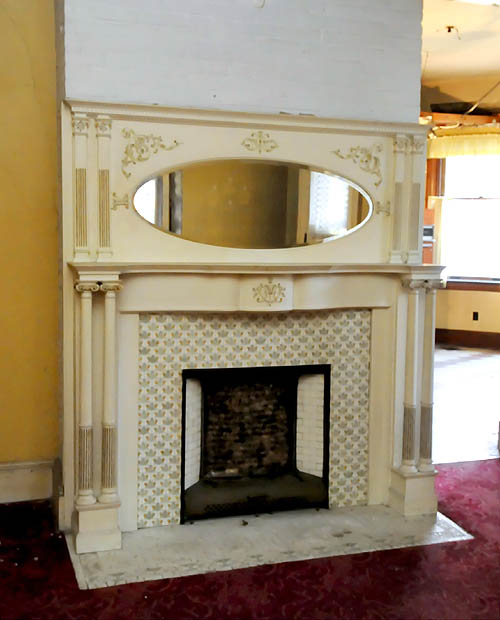
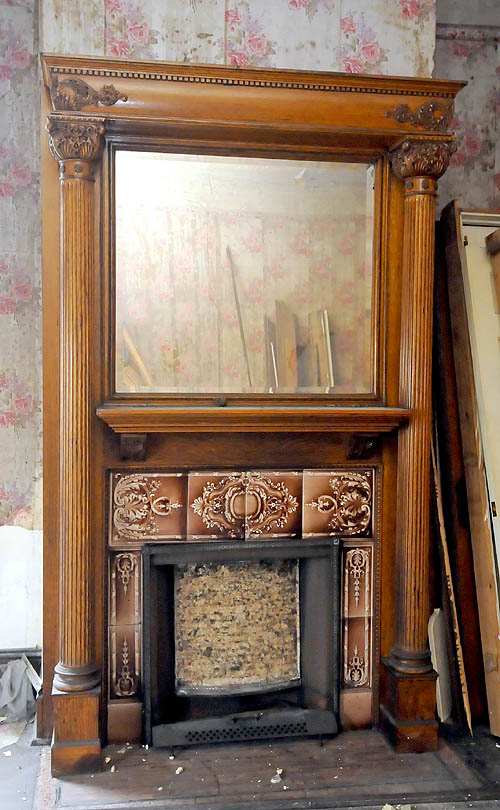
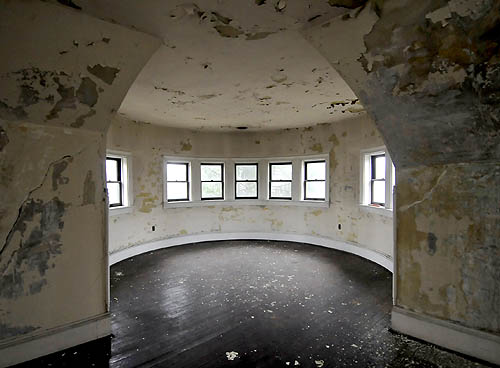
According to the article on the Post Gazette website, written in 2008, this home was split into 13 bed, 5.5 bath apartment building (not sure at what time it was reduced to 6 beds.) It features 12 fireplace mantels, pocket doors, leaded and stained glass windows. I don’t know what, if anything, has been done since 2008.


FavoriteLoadingAdd To Favorites
**I am unable to keep up with listings that sell or become inactive. If you are interested in a home posted, always check the listing link provided or contact the agent for more information. Just because this site says it is 'Active', 'No longer listed' doesn't mean it still is.

Disclaimer: I am not the listing agent for this home. Contact details for the agent is available in the post or listing page. Information provided is deemed reliable but is not guaranteed and should be independently verified. Unless otherwise noted, all details about the home come directly from the listing information and photos are provided by the agent or listing office. Posts are deleted (to help with managing the site), so if you want to keep pictures of any houses be sure save them to your computer.

56 Comments

JulieMarch 1st, 2012 at 5:29 pm

Get that lead based paint disclosure signed; preferably before entering!

[Reply]

VickieMarch 1st, 2012 at 5:43 pm

Sign me up!!

[Reply]

RyanMarch 1st, 2012 at 9:38 pm

Nice! This house is so roomy and has lots of nice features. It does seem to have great potential, too…if this town could possibly support something like a Bed & Breakfast. The neighborhood is very attractive and looks to be well kept. The only thing is…I’d be embarrassed to tell people that I lived on Beaver Street in the heart of Beaver, in Beaver County yet!
:)

[Reply]

John C Reply:

Do you know a Cleaver family? That would tie it all together.

Also the potential B & B would be a B & B on B, in B, next to the flowing B. I think this is ad executive’s dream.

[Reply]

MarkMarch 2nd, 2012 at 10:27 am

Ryan, it’s also right near the “Big Beaver” river.

I don’t think you’d want to open a B+B in Beaver. It’s fairly run down.

[Reply]

Mark Reply:

….and I think the $169 price is fair to use it as a multiple unit residence, as it has been. That’s probably how it gets to that price point. If considering returning it to a single family residence, I thinks it’s overpriced.

The fact that it’s a multiple unit essentially tells you about the area as far as the economics of the neighborhood.

[Reply]

JimMarch 2nd, 2012 at 10:54 am

Love this place, exc. for the location, condition and the green.

[Reply]

TracyMarch 2nd, 2012 at 11:02 am

A former beauty. What a shame…

[Reply]

DebbieMarch 2nd, 2012 at 11:10 am

I don’t know. Despite the horrible name, the lead based paint, the impovershed neighborhood, I would still buy this house – if I had the money. When, when will my lottery come in!

[Reply]

John ShifletMarch 2nd, 2012 at 3:49 pm

This was obviously a grand home back in the days when a staff of servants was necessary to keep up a home of this size. Inflation and structural economic changes since then have largely wiped out the upper middle class servant staff phenomenon for all but the very wealthy. Only someone with at least $500k-$1 million to spend on restoration could ever hope to bring the old manse back to a semblance of its original glory. Alternately, an investor might rehab it for continued rental use but even with historic tax credits, it would take quite a while to realize any return on investment. Still possible would be for someone to live in it and slowly restore it one room at a time but that would only buy the house more time, unless the aforementioned required large sums of money were later available. (as in someone’s rich uncle died and subsequently left them with a fortune to finish up the restoration) Beautiful house here with some very nice period details but also strong visible cautionary signs indicating a “money pit” situation. Not a good project in this example for an old house beginner or for the shallow of pocket.

[Reply]

Jim Reply:

John, I have no quarrel with your basic take on this house, and clearly your estimate of $500K – $1MM makes the full restoration of this property infeasible for any private party to undertake. It simply makes no economic sense. But I wonder if the house could be made livable and enjoyable for a far lower figure, assuming no major structural problems exist. Obviously, it’s impossible to assess it accurately based on a few photos, but I don’t see anything, besides possibly the front porch, that would require complete reconstruction. Your figure is $80-$160 per sf is almost in the range of new construction.

[Reply]

John C Reply:

That is a perceptive comment, Jim. I recall being in the house — a former abbey — where part of Spenser’s Faerie Queen was written. It was (in the 1960s) a cold house, vast, poorly lighted and with little electricity in some of the rooms, with some missing plaster and little paint in most areas in many, many years. Yet for all that the house was lived-in, with great joy, by a family that included an artist painting huge canvases, a daughter who was working as a blacksmith farrier, and a father who designed the prince’s crown for the then recent investiture in Wales. Everyone led useful, productive and wonderful lives. The house was in stable condition, although in terms of full restoration it no doubt would seem a ruin. If a house is stable and the family is strong enough, a great many amenities can be done without so long as there is room for all the family activities and a joint willingness to be active.

Of course for some of us full restoration is one of the prime activity and objectives. Others may be content with one or two rooms restored fully and others left rough, in order to achieve other goals. A family that has a house left untouched but matained as it is, will hear no complaints from me if they fiill it with love and activity. That is what all houses, new and old, are for.

For any individual and the decisions to be made, all this is a very complicated weighing of just what one wants, in what locality and structure, and what that given structure can do.

Of course, my comment is nothing new. As always, I find the comments on this site and the selections by Kelly stimulating and near-essential in development of my own thinking. I will think this posting and these comments over for some time to come.

[Reply]

John C Reply:

I think John Shiflet’s comment on another house, the one at http://oldhousedreams.com/2012/03/01/1880-italianate-watertown-ny-499500/ , illustrates the other side of the coin. There is a beautifully maintained home, very spacious, etc., but in a location where one assumes there is little of interest to do, with winters long enough to give one cabin fever, all the while paying out extraordinary sums in property taxes and other charges. Of course, all of those assumptions may be subject to challange and qualification: John himself points out the possibility of internet business occupations and one might find Watertown vibrant etc. Still, a home — even a beautiful and fully restored home– is a useless burden to someone unless the life to be lead there is happy and productive in all or as many aspects as possible.

Kelly does so much bringing to the site and to us these examples from all around the country. But they are examples of real estate available, and the difficult part begins only when they are presented: each of us has to think what would we make of the particular house presented and of our life there. That is a difficult detailed question, of course, and so many of us use shortcuts: too expensive, no probable occupation opportunities, etc. I don’t see any way around that. It is unfortunate because it is negative thinking, those shortcuts, and thus some possibilities are lost and not realized even to exist.

Again, I realize that my thoughts are not everyone’s thoughts or even concerns, and I beg indulgence. How provocative (in the best sense) this site is! Thanks to all and especially Kelly!

[Reply]

John Shiflet Reply:

Could this house be restored for less than $500k? Maybe, but that guesstimate was based on replacing the electrical, HVAC, and plumbing systems, as well as dealing with smaller issues like basement seepage (if it exists) roof leakage, (if any) repairing or replacing deteriorated porch elements, repainting the exterior and interior, refinishing the floors and millwork, repairing any damage caused by being divided into apartments, relining chimney flues for any wood burning fireplaces and retrofitting gas log type burners in the smaller coal burning fireplaces, attic insulation, updating the kitchen and determining the needs for updating the 4.5 bathrooms. Last would be landscaping and repair/maintenance of any outbuildings. The large trees near the house represent a wind damage hazard-while I love mature trees they should not be next to a house. Have I gotten to $500k yet? But I did say that someone could take a minimalist approach for far less outlay but in my opinion that would merely buy the house some time rather than make it ready for another hundred years of use. Jim is 100% correct in that my figures are merely guesstimates and the total outlay may be less or more depending on the actual condition of the house. Every old house buyer would be wise to hire a third party home inspector familiar with old houses for an unbiased condition report.

As for the surrounding community, the regional economy, climate, demographic mix, and other important factors, a potential buyer would be well advised to devote their time to study all of these important aspects of quality of life before buying any old home. I met a family originally from North Carolina a few years ago who had bought a large Queen Anne style home in Uniontown, PA. They, for all practical purposes, had bought their old house sight unseen with zero knowledge about the community. Fast forward a couple of years and their children keenly longed to be back in NC. The kind of work the husband did was in slack demand. They had already decided to sell and go back to their home state because they still loved the old house but disliked the community, the local economy, and the general quality of life there. All potential old house buyers need to carefully evaluate important aspects pertaining to the location as well as inspecting the old house itself.

[Reply]

Jim Reply:

John, I wish that your analysis was way off for the sake of the house, but I don’t doubt that someone writing checks for the renovation here would be into it for close to a half-million before they were through, if not more. Most folks today require up-to-date systems and amenities, and shabby accommodations are only acceptable for the poor. Apparently this house fell below even those standards and was vacated.

There are many people who have the money to put into a project like this, but only a few who would live in a “seen better days” neighborhood in Beaver PA, especially if there was little prospect of getting their money back. That leaves only a few random millionaires who might fall in love with the place, or maybe a local contractor that can fix it up on his own time and showcase his abilities. It’s wishful thinking on my part that the total cost could be kept within a moderate range to increase the potential pool of purchaser-renovators.

The only near-comparable fixed-up place in the area has been on the market for quite a while:
http://www.prudentialpreferred.com/real-estate/index.cfm?fuseaction=property-detail&proptype=res&MLS=904259

[Reply]

John CMarch 3rd, 2012 at 1:42 pm

Very well said, John, and very well thought out. And I think the example you give goes to the heart of the decisions many of us have to make!

[Reply]

Robt. W.March 3rd, 2012 at 6:29 pm

Hard to say how badly the house suffered from being chopped up into many apartments, and variously reconfigured, but expect it could be made solid and handsome for under $500K, perhaps even $300. But in Beaver PA, in that somewhat rundown looking setting of lesser houses, it’s maybe a lot to ask that that much would be spent (the comparable total money spent in the same region can go pretty far.)

[Reply]

MarkMarch 3rd, 2012 at 6:44 pm

Funny that John mentioned Uniontown. I was going to lump Beaver Pa in with numerous others areas such as Uniontown, New Castle, etc. in Western PA, in that they have/had tremendous housing stock that basically are on a downward spiral. Essentially everywhere in Western PA that was once a small city falls into the same boat.

Beaver has its own hospital and some places to work. It’s also 35 to 40 minutes to the city area of Pittsburgh where there are lots of places to work. In theory, it should doing ok.

However, this house would have to be in reasonable move-in condition to be priced at $169,000 in Beaver. Adding several hundred thousand in repairs makes it unsellable. For half of the $695,000 of the nearby property, one could purchase two move-in ready historic houses in the best Pittsburgh suburbs, or one really nice house even closer to town in the best neighborhoods of the city. The problem may be the largest local city has too much to offer in comparison to these outlying large towns.

[Reply]

RyanMarch 3rd, 2012 at 10:15 pm

Other websites have this listed at $149,000.00 now. It’s hard to tell a lot without actually going there, but I don’t get why people are saying this is a bad neighborhood. From what I can see, it’s full of big old houses that all appear to be very neatly kept. There are mature trees lining the streets, and there’s a leafy park nearby. Beaver’s downtown area appears to be clean and active, and I don’t see any glut of burned out buildings, or empty storefronts, or anything like that. In this particular neighborhood I don’t see any run-down houses at all. Plus, when I looked for similar real estate listings, I did see some large Victorians in the same general area of Beaver, Pa, and all of them are asking a WHOLE LOT MORE than 149 grand. A simple 3 or 4 bedroom brick Victorian in this neighborhood seems to average about 180 grand, but there are larger homes (five or six bedroom places) that are listed for as much as $700,000.00. Obviously the condition of any such house would prolly be much, much better than this one, but still…this house doesn’t seem like a totally lost cause to me. Maybe I’d have to visit the town in person to see what others are talking about.

[Reply]

Bob HMarch 4th, 2012 at 10:11 am

I think for this house and town–that area of PA for that matter–this has to be a labor of love and a lifetime investment.

Make it as beautiful as YOU want and live in it and use it with the knowledge that it will not return your investment in $$ but it will give you return in satisfaction that you saved a grand house and get to live like a Baron for little $$ (providing it isn’t collapsing…)

[Reply]

John CMarch 4th, 2012 at 10:22 am

I just noticed this morning that the price has been reduced to $149,000.

[Reply]

John CMarch 4th, 2012 at 6:17 pm

As to “neighborhood” and the fact that some are referring to the neighborhood as well-kept, etc., and others as impoverished, I am becoming confused. Are people referring to the immediate neighborhood of the house or, instead, to Beaver, Pa (the borough in the county, etc.)? The Wiki reference says that almost the whole community of Beaver is in an historic district designation, that the poverty rate (as of 2000) was 3 or 4 per cent (depending on whether one viewed individuals or families, that the median income for a household was $42,000-odd and a family some $56,000. Even given that costs of living are higher, no doubt, here than in many other locales, those are pretty impressive figures compared to other towns presented on this site.

I thought at first blush I understood the reference to lesser houses. However, Beaver may be one of those towns where larger houses were built next to “lesser houses” and, as to at least one other town (St. Joseph, Missouri), I thought some indicated that having the nicest house on the block, etc., was acceptable if that was the pattern of the town. Besides, others have indicated that there are large homes near this house. I myself have not been able to google-map this house at streetview to see the immediate housing stock and street.

The one thing I am certain I understand is that the proximity of suburbs adjacent to Pittsburgh and Pittsburgh itself renders the price on this house too high, given what is comparable and available in those towns and that city. Moreover, the “amenities” that John correctly says most people want and that we assume this house does not have, do have a cost. If one assumes that the closer-in suburbs and Pittsburgh have better houses that are comparable in scale and architecture, at a lower price, then of course this is over-priced and that is an end to the matter.

However, am I correct that if this house, as listed and described so far as we know it, were available at, say, $44,900, we all would believe that this could be a potential bargain? I am thinking of the South Boston Virginia house at http://oldhousedreams.com/2011/09/01/1910-eclectic-s-boston-va-73900/ That is another brick house in bad shape. That, too, had been a multi-family, and although it is in a town with larger homes nearby the town has poverty and income figures worse, I think I remember, than Beaver Pennsylvania. What prompt me to ask this is that I do not recall quite such an intense discussion of possible resale values, restoration costs, etc., as to other posts. Does the discussion reflect the fact that the house is tempting?

[Reply]

Jim Reply:

Beaver PA is by no means impoverished, blighted or crime-ridden. The demographics compare favorably to most of the towns surrounding Pittsburgh. There are many towns in the region that have suffered far greater in the last 50 years of economic contraction due to the loss of the once huge industrial base. Beaver was never a suburb of Pittsburgh, and there are attractive suburbs closer in that have captured the upscale old and new home markets. I suppose Beaver could be considered a lower priced alternative, but there’s lots of competition. I said that the neighborhood has “seen better days” only because many of the older houses have been converted to rentals and don’t reflect pride of ownership, not to suggest it was a bad place to live.

Obviously resale is an important consideration before someone is going to invest upwards of a half million dollars total into a house. I’m not talking about flipping the house for a profit; that seems out of the question. But loving an old home and the quality of life it can provide over the years is not going to overcome the concern a family might have for their life-savings being tied up in a potential money pit. In a major metro area, the risk is less because the housing markets are much more predictable, or at least were until the last few years. If this house were in a good New York suburb, the market would price it accordingly and it would have been bought and renovated (for better or worse) years ago.

There’s a huge difference, both in dollars and level of risk, between a $45K house in S. Boston VA that someone can move into and fix up as much and as quickly as finances allow, and this place which is $150K plus maybe $100K just to make it habitable, plus who knows how much in the future to restore it. Unfortunately that’s not a risk that anybody has been willing to take.

[Reply]

John C Reply:

I think that, as I remarked a moment ago in regard to John Shiflet’s examples, that the matter is now resolved. Jim has pointed out the forumulae: huge difference in dollars and level and risk. I don’t mean that we are all bottom-feeders, but our analysis, by each of us, seems intelligently geared with these explanations. Ultimately those calculations depend on an initial price.

The South Boston place needed a new roof immediately and had damage upstairs, if I recall the comment by the prior realtor. Still, I thought that in the abstract at the price then (around $59,000, before the latest reductions, if memory serves me right), the South Boston home was in the range of “doable”. It would certainly seem to be so now, subject to a thorough inspection.

My only lesson to myself in these matters is to take comments about the neighborhood, etc., with a different point of view. Such critical comments are probably not, in the final analysis, deal-breakers, but they assume importance to us if the price seems too high given, as Jim says, risk and costs.

Ryan, thanks for the aerial view report! That is helpful.

Now all we need to do is reassess if and when the price begins to be substantially reduced!

Thanks, everyone.

[Reply]

Robt. W. Reply:

All good points. From afar, a low price grabs attention (and sometimes visions of living like a prince, but for mere peanuts.) Most of us, though, are from afar, and however theoretically ready we might be to pull up tent stakes and move across state or states for the right house, there are a lot of factors that go into that decision.

Sticker price may be important, but there’s a larger “whole cost”: taxes, relocation, cost of renovation/maintenance, cost of living, but also less tangible factors like setting (immediate, town, region, access to amenities) and “livability” demographics concerns that are highly individual.

For historic houses, one buyer’s $149,000 house may stretch their budget; another may have to stage slow improvements over a long time; and a third may fully anticipate spending multiples of the purchase price at the outset. It may represent a large investment for one person, a lifetime labor of love for another, or a mental more than a financial challenge for another. Some buyers are so taken with a house that they will make what others regard as hard sacrifices on its setting; others want the right historic house no less, but also want to be in a beautiful setting, or among like minded people, or close to an international airport, or a college town, or some complex combination.

If buyers of new houses tend to buy more within expected bands of pricing relative their income and resources, that’s less routinely the case with people who “Will Move for Dream Old House.” A lot of historic houses may start out priced optimistically for that very same ideal buyer from anywhere, but far more often they end up selling at a price more in line with the similar house two blocks away.

[Reply]

RyanMarch 4th, 2012 at 8:02 pm

“As to “neighborhood” and the fact that some are referring to the neighborhood as well-kept, etc., and others as impoverished, I am becoming confused.”

Welcome to the club, John:) I have never been there, and I couldn’t find any google street view that worked, but I did carefully scan the neighborhood using Bing’s Aerial map. This house is bigger than most of its neighbors, but there are still plenty of other very large homes nearby. There are a number of very expansive, seemingly well-kept Italianates, Queen Annes, Tudors, Georgians, Colonials, etc., etc., etc. on this same street as well as on the surrounding blocks. I can’t figure out why anyone would say it’s an unattractive or impoverished neighborhood. To me it looks lovely and appreciated.

[Reply]

MarkMarch 5th, 2012 at 12:08 pm

Jim’s argument is right on the money about the house and the neighborhood. This property would never be for sale(essentially for 4 years now) if it could compete with other properties in the region.

It may be a 6000 square foot mansion, but it’s also a fairly common 6000 square foot mansion for the area.
Honestly, I’ve seen houses comparable to this for sale at around $100,000 in Western PA and they were lived in single family homes.

[Reply]

John Shiflet Reply:

During our short visit to Western PA in 2009 we visited Uniontown, Washington, tiny Millheim in Centre County, and Ridgway+ Bradford near the NY state border. Mark is correct in that 6,000 sq. foot mansions in the smaller towns are common. Here’s a few photos of Washington’s wealth of old homes as well as a half-dozen photos at the end of this set from Uniontown: http://www.flickr.com/photos/11236515@N05/sets/72157618437859030/ There’s some irony in that very large old homes with incredible period details are often difficult to sell at any reasonable price. The upkeep on a 6,000 sq. ft. or larger home is always going to be more than for a house under 2,500 sq. ft. Ditto for keeping it warm in the winter and cool in the summer. Property taxes are going to be higher. And, as stated, there are a LOT of these big old houses in Western PA but few people with the means to restore them and even fewer who are willing to relocate there. A net outward migration has been the regional pattern for decades, especially in the southwestern PA region closest to West Viriginia. I don’t have any suggestions or formulas for selling a house like this one but I do believe it will have to be priced somewhat lower for it to sell. When we visited Bradford, there were several houses of this size and grandeur priced in the $115k to $135k range and two of them have since sold. (to out-of-staters) Here’s some Bradford photos and a couple of nearby Ridgway PA photos: http://www.flickr.com/photos/11236515@N05/sets/72157618714282071/
Ohio, western PA, and western NY, have some of the best old house deals in the country provided the buyer is willing to cope with all the other factors that are a part of living in these areas.

[Reply]

Jim Reply:

John, thanks for the photo links – and all your work to document and preserve historic structures.

[Reply]

John C Reply:

John, I join in all those sentiments. You are remarkable in what you do, what you know and what you intuit and distill from what you know and give so freely to others! I think this information adn thess exaamples resolve my questions.

[Reply]

John Shiflet Reply:

Thanks for all of the kind words. I’m passionate about saving and preserving old/historic homes (the argument here is that every home has some kind of history imprinted on it by the passage of time, though not necessarily an important history) We are literally in a preservation crisis nation-wide brought on by the collapse in real estate markets. Some cities are dealing with the crisis by opting for mass demolitions; other old houses in more remote areas and/or smaller communities slowly deteriorate and fade away on their path to eventual ruin.

If anything I may suggest helps to save even one worthy old house then my time here is well spent. Historic preservation sometimes runs against the American cultural ideal which nearly always chooses the new and shiny over anything old and faded. Genuine early Colonial era houses were being razed in the 1800′s for the same reasons that we now demolish houses from the 1800′s and early 1900′s (or even later)

While it may seem to us (from this site) that there’s a large body of caring people about old houses, the reality is we are a small subset within the general population; far more folks wouldn’t be caught dead living in an old house. Thanks for being part of this small “old house” club and thanks to Kelly for making it happen on these pages in the unique way that she does. I feel privileged to share my comments here. If I were to set up my preservation soapbox at the local Mall I’m sure I would be talking to myself. You folks are really special and I mean that in the kindest way.

[Reply]

Kelly, Old House Dreams Reply:

I had to smile at the “…we are a small subset…” line. Mostly because apart from my own family, my in-laws know nothing about me having this blog since they are kind of anti-old anything (they call antiques “junk” and more recently said that my husbands grandmothers 100+ year old home should just be torn down, gasp!) It’s far easier to let them think I watch soap operas all day and eat bon-bons than to explain why I do what I do. And strangers, when they’ve asked what I do, their eyes go blank when I tell them about the site. I’m then reminded that not everyone loves old homes. :)

[Reply]

Robt. W. Reply:

Ha! A secret life.

Years ago some acquaintances stopped by my house and I could tell that they were appalled that everything was old. Later invited to party at their place, I couldn’t locate a single thing that was old. Even their couple of “antiques” were spanking new.

Besides the real estate crisis that John Shiflet cites, I think there’s another shift had hold before the downturn in housing. It seems to me that in the 1980s was the flowering of historic preservation and that enthusiasm has since waned. Increasingly it seems people want only a vestige or two of something old, or as they more likely say the “authentic character.” In fact, they’re not much bothered by authenticity at all, and give it up in a heartbeat. The antiques trade underwent the same shift: the once thriving middle market has withered, the junky low end is a hard sell, and only the very top tier of quality does well. Where once people wanted to furnish their historic houses with antiques, they’re now happy with one or two “sculptural” or “whimsical” pieces — they don’t care about age or provenance or connoisseurship, they just want one random eye-catching thing, whether it’s a piece of a plane propeller or one little crumb left behind of an old house that’s been gutted and everything old made flashy and new. “Sensitive restoration” has given way to “gut job”, the answer to anything involving an old house, and many buyers seem happy only when their crown mouldings are fresh from Home Depot and everything slick and shiny and brand spanking new. Increasingly, even as historic preservation has become an accepted fact in many places, it seems that “old” is a dirtier word now than it was 20 or 30 years ago.

[Reply]

John C Reply:

As always, your perceptive remarks lead to some thinking. A small part of the problem, perhaps, is that “gut rehab” has some hugely positive cash consequences. (1) At least in the Chicago urban area, State Farm and many other insurers will not insure an older home/duplex/triplex, unless the company is assured that the house has had a gut rehab within a certain number of years, in which all wiring has been replaced, piping, etc. (2) Banks and appraisers are happiest when they hear those words. (3) Those seeking to rent houses or to buy them love to hear the words as well.

On the other hand, as you truly state, historic preservation — along with the less hi-falutin’ repair and fix-up — is becoming accepted. Part of that, to be frank, is the economy. I know of a number of families looking at larger, old homes to houses multi-generational and extended families, the members of which plan to live together to economize. I also know of some unrelated people — people on disability and/or retirement — thinking of becoming “roommates” in old homes, a sort of Fawltey Towers where the roommate situation will avoid tax consequences.

We live in interesting times, as the Chinese curse goes.

[Reply]

Tracy Reply:

I once asked my grandmother (who started her married life in the Depression) why she had so few antiques in her house. I was (and am) heavily into them and couldn’t understand why she had so little to show after so many years. For her, she had cast them off over the years because they reminded her too much of the “bad old days” such as waking up to frost on your covers, mice running rampant through the house, long hours in front of a wood-burning oven, outhouses, etc. By having everything new, she could revel in all the conveniences that modern living had to offer.

I was born and raised in a farmhouse Bungalow, and my mother hated nearly every minute of it. She and my dad renovated it by getting rid of nearly all vestiges of the original house and filled it full of miles of paneling and green textured carpeting with some Danish Modern thrown in. (shudder)

I totally agree that people are not as interested in the quality craftsmanship of old homes nor the upkeep associated with them. Let’s face it; most people are only interested in staying in a house for maybe 10 years before they upgrade or transfer to a new job in a new town. What’s the point of starting a renovation in an old house when life has become so transient?

A couple up the street from us attempted to sell their modest Craftsman with natural trim and built-in buffet but they couldn’t compete with the glut of new housing a couple miles away. No one wanted an old house when they could get a brand new one chock full of new appliances, white tile, and a sea of white trim for essentially the same price. Who cares what the new place will look like in 10 or 15 years? They’ll have moved on to the two-storey with a three car garage in another subdivision by then.

We are a society surrounded by disposable products whether it is Blu-Ray players, TVs, houses, furniture, or what have you. Our economy seemingly depends upon this constant flux of products through our homes, replacing what is tired or broken with new. Houses are now the same. Throw ‘em up overnight and when we get tired of them, move on to the next.

We are a special breed; we thrive on and find enjoyment in the rich history to which we tether ourselves. There is something about being part of something that is larger and deeper than one’s personal experience. For me, that is being in close proximity to antiques and my old home. It allows me to dream of different days, simpler, but also harder in many ways. You won’t find any experiences like that in any house in a cookie-cutter subdivision with an “E” added to the end of the name to vainly add a sense of luxury or uniqueness.

Pardon my soap box… As others have said before, thank you, Kelly, (and everyone else on this forum) for providing an outlet through which we may vicariously experience other locales and homes through your kind generosity.

[Reply]

DebbieMarch 5th, 2012 at 3:08 pm

Thanks so much for the photos. I am learning so much from this website and I love the debates! I see now when I win my lottery, I will have to head to Uniontown.

[Reply]

Jim Reply:

Debbie, if you win the big one and want to relocate to Uniontown, you might want to look at this one:
http://isaacmeasonmansion.com/for_sale1.htm

[Reply]

Ryan Reply:

Yeah, Kelly posted this one on her old blog (I think it was the old blog anyway) and added this page, too. Sad story.

http://oldhousedreams.com/2010/09/24/isaac-meason-mansion/

[Reply]

John Shiflet Reply:

Actually, I was more impressed by what Washington, PA had to offer but Uniontown does have a few gems. Almost every community of any consequence in western PA has architectural treasures to be admired. What I’m afraid of is that someday one of the folks here will announce that they actually DID win the lottery; the question then is will they (buy that old dream house) or will they not? Good Luck…

[Reply]

Robt. W. Reply:

Washington PA had several very fine early 20thC, architect designed Colonial Revival and Tudor style houses for sale a year or so ago, each large with 5 or 6 bedrooms and generous rooms and great butler’s pantries and sophisticated detailing and materials, and each sitting on large park-like lots of a few acres with apartments over large original garages and all the rest, and set within the same small but cohesive neighborhood of comparably good houses. All were very sturdily built and beautifully maintained; a couple had $100K kitchens that were not flashy and trendy, but done to a high standard and not out of sorts with the architecture. All were in the range of only $250K – 450K, and were for sale long enough that I suspect that sold for less.

Despite the stylistic differences, it if were just a matter of value, the Washington houses had it all over the Beaver house. Both towns are practically the same distance to Pittsburgh, and though Washington has the advantage of a college, the real difference was a beautiful setting and move-in ready houses that don’t require a good $100K to make a dent in what absolutely needs done and maybe times two or three more to bring it to the finishing off point. It’s always apples and oranges, but that part of Pennsylvania has a richness of choice of great, cheap houses.

[Reply]

MarkMarch 5th, 2012 at 4:53 pm

Or not!! Don’t get started on that one!!! It’s been for sale for about ten years and surrounded by abandoned cars, bad neighbors, legal issues, etc…
http://www.post-gazette.com/homes/20020623meason0623fnp2.asp

[Reply]

Robt. W. Reply:

Ouch.

At this stage in historic preservation, it’s a pity so much of the available grants are still tied to federal money (channeled through states) for tax incentives on commercial buildings and tax incentives through the Historic Preservation Fund. Thirty years ago that made sense, and it still does some places, but rescuing the landscape context of highly significant sites would be a better application of money in other cases.

It sounds like the only solution at Mount Braddock (Meason House) is a buy-out of the neighbors whose property wraps (and spoils) the place. It’s a lesson, too, in not underestimating the value of setting when buying.

[Reply]

Jim Reply:

Mark, that’s a very old article. Apparently the neighbor has cleaned up his property considerably. The owners deserve credit for starting the restoration, but they’ve also created problems by overstating the threats and holding out for a large profit. The fact is they have been in way over their heads from day one. The property and surroundings could be taken by eminent domain if there were the political will to do it.

[Reply]

CourtneyApril 1st, 2012 at 9:10 pm

I am in love with this house! I am trying to figure out a way that I could live in it and fix it up but it seems impossible! It has a really great school district and such a charming town!! I drive through there often and though I would love to live there and only a short drive to Pittsburgh from there! It is truly my dream home I can imagine the rooms finished with a bit of old fashioned charm and the modern amenities of today watching my children grow up there and living there for the rest of my life even passing the home down through generations. I have been reading through the comments and hearing things about led based pain which I couldn’t have my children near obviously. I would just love to restore it to it former glory! Who knows maybe I will!

[Reply]

Jim Reply:

Go for it Courtney! The lead paint won’t hurt the kids unless they eat it, which shouldn’t be a problem if you feed them! Seriously, that’s a big project, but if attitude alone could get it done, you would be the perfect candidate.

[Reply]

John Shiflet Reply:

Lead paint is a real risk in old houses; however, as Jim has pointed out, the main risk is ingestion of paint chips or exposure to dust if any paint is being sanded nearby. One restoration manual I have states that in the process of sanding, fine lead particles of paint can remain suspended in the air in a closed room for up to 52 hours. But the risk of lead paint exposure can be minimized in several ways. The easiest is encapsulation…in simple terms, paint over the lead paint layers with a modern primer (KILZ 2 for example) and then top coat over it thus trapping the lead layers below it. Another is stripping with chemical based strippers. The old Methylene Chloride based strippers were awesome but were also quite hazardous in themselves. The newer citrus and soy based strippers are more expensive and take longer to remove multi-layers of paint but are far safer to use. Last, in the hands of someone with lots of experience, a small heat gun (emphasis on small) can be carefully used to remove multiple layers of paint but there is an ever-present fire risk; whenever I use heat to strip I always have a small water sprayer at hand and pre-moisten any area that poses a hidden fire risk (cracks or holes that go behind a wall for example) and make sure I keep the heat gun the maximum distance away from the surface that will still allow the paint to soften. I also keep it set on the lowest heat setting that still allows the paint to soften. Extreme patience is required along with careful attention to the stripping process. If you’ve never used a heat gun to strip, then DON’T. Too many fine old houses have been burned to the ground by workers using heat devices to strip old paint. NEVER, EVER, use one of the old hand-held blow torches to strip ANYTHING, the fire risk is extreme and damage to the wood below the paint layers is very likely. Electric heat guns (again, small ones) are somewhat safer but all come with an inherent fire risk.

As for hazards to children, the younger they are the more vulnerable they are to lead exposure. Infants and toddlers should never be exposed to lead particle risks as such exposure can cause brain and central nervous system damage that is irreversible. Children over 5 are still at some risk but all childern should be kept away from any work environment where lead exposure is a possibilty. The EPA greatly tightened the rules for lead paint abatement a couple of years ago and require lead remediation certification for all contractors engaging in that kind of work. Read the EPA regs concerning lead paint remediation for interior work as it may not even be legal in your location for a homeowner to strip exterior lead based paint. I personally think the EPA went a little overboard with the stricter rules but if they keep just one child from having permanent CNS damage due to lead particulate exposure, then it would be difficult to argue against it. Asbestos is another common old house hazard and best left up to a professional to deal with. Old furnaces and boilers were often insulated with asbestos and it is most hazardous when it is fraying and fiberous. When the microscopic air borne asbestos fibers are inhaled they lodge in the lungs and over time lead to mesotheliaoma, a fatal type of lung cancer.

At one time arsenic was used as an ingredient for green colored wallpaper inks and paints. Our ancestors would have surely refrained from using so many different hazardous substances but the level of scientific knowledge back then was insufficient to recognize the long term risks. You’ve probably heard of the “Mad Hatter”…because hat makers used mercury in the process and over time exposure to high levels of mercury can cause brain damage and insanity. Common sense should come first before any old house restoration project. Successful old house restorers always carefully evaluate every project for safety and with great patience and a thorough understanding, tackle the challenges.

[Reply]

Courtney Reply:

I am glad you mentioned the asbestos, I completely forgot about that and the risks involved with it. Also I wasnt aware of the arsenic risk. These are all things to be considered for sure!

[Reply]

John C Reply:

Courtney, John Shiflet’s words are always well-chosen and his thoughts always well-framed by experience and reading. More important, despite all that experience and knowledge, he still sees clear the dream of living well in older homes of grace and beauty. Get what advice you can from that wonderful fellow, is my suggestion.

[Reply]

Courtney Reply:

Well maybe I’ll need his cell number if I decide to take on this house! It’s funny how I see this house and it pulls on my heart strings. There was one other home near me that did the same and is currently being restored by and great family. I just find the Queen Anne style to be what appeals to me the most. If this one is not a possibility I will hold out until there is one that I can handle.

An Mr. Shiflet I will gladly take any words of advice you may have!

[Reply]

John Shiflet Reply:

Thanks for the kind words, We’ve lived in our own “project” house for nearly 23 years and despite almost countless hours spent on it, it remains a work in progress. Ideally, we’d all have enough money to bring in expert tradespeople to do most of the work for us but wealth and old house people seem to be at almost opposites. If nothing else, we’ve bought our old home (c. 1889) another quarter century of survival and it will be for others to see the restoration work to completion. I see nothing wrong with taking a room by room approach and taking care of the essentials (roof, foundation, electrical/plumbing/HVAC) on a priority basis. We lived with a primitive 60 AMP breaker box and knob & tube wiring for almost 20 years before finally upgrading to modern standards. When the microwave was going and a window A/C unit on the same circuit was turned on, it would only take seconds for the breaker to kick out.

It all depends on what you can comfortably live with…my spouse insists our next old home will NOT be a perpetual construction zone..but for almost 25 years, we have tolerated it. By the way, the peeling white paint seen in the attic or upstairs is probably NOT lead based paint. A very common and cheap interior paint of the past was Calcimine paint, a form of lime-based interior whitewash. Here’s a good article on how to deal with it from a pro: http://www.plasterlord.com/notebook/fcalcimine.htm
Good luck with finding and purchasing your dream home be it this one or another. I’m always happy to offer free advice based on my long years of experience in old house restoration. (BTW, I can be PM’ed at vintrest@yahoo.com or 817-332-7016)

[Reply]

Courtney Reply:

Thank you so much I’ll keep you guys posted on what I decide! I have a feeling it may not be achievable at least for me at this moment in time. If this one can’t happen maybe I’ll find one on a smaller scale that’s more attainable!

[Reply]

John CApril 2nd, 2012 at 9:32 am

Courtney, I’m sure everyone who frequents this site, just like Jim, warmly encourages you, after you have done all your thinking and figuring, to do what you think is best. Dreams and aspirations — rationally calibrated and thought through — are what makes life worth while; your dreams and aspirations are what make you, you, and at some point and in some way you will act upon them. IT is best to do act upon them as you are doing it now, carefully and with caution, rather than to pent it up until you recklessly act on some other ocassion. And of course I am saying those words to myself far more than I am saying them to you.

I agree with Jim that unless one encourages children to eat paint chips (or, to put it another way, likes peeling paint and paint dust decor), one runs little risk of exposing children.

Best of luck whatever you decide to do!

[Reply]

Courtney Reply:

John,

As much as I want this house I know it’s a huge project, I wouldn’t jump in with a blindfold on :) I am defiantly in love with it even though my husband just sees a money pit and I agree with him on that. I am actually having a good friend who is an electrician and a contractor look at the home and see if it is actually a possibility to live there and fix it up one room at a time. I haven’t been inside the house yet so I have no real idea of the disrepair. I am interested in the electrical, plumbing, roof, foundation and the basement as well mold and things of that sort are to be considered as well. Like I mentioned I have children and it has to be livable. I think my children are too old to eat the paint ha ha. I have no real idea on anything that would have to be done I have never attempted to do any sort of DIY things in any home because I have never own one. I caught sight of this while looking for a home to buy for the first time. As much as I want this place to be mine I fear it is too much for me and my wallet but we will see after I have my friend looks at it.

Although if I won the lottery like someone else mentioned I would be on it in a hear beat!

[Reply]

John CApril 2nd, 2012 at 1:43 pm

If you decide against this one, there will be another house coming up to suit your dreams — Kelly will find it. And your sound thinking-process means your ultimate dream will be rewarding.

[Reply]

CourtneyApril 2nd, 2012 at 6:56 pm

Just got a message that the house has been sold! Hope they love it as much as I do :) I’ll keep my eye out for the next one.

[Reply]

John CApril 2nd, 2012 at 7:22 pm

That is the spirit. Often, too, the next one is easily noticed, appearing about an inch away from your face. Here’s hoping.

[Reply]

Leave a comment

Your comment

Comments may be deleted if deemed inappropriate, click here for more info. Don't forget, turn off your CAPS LOCK before commenting.
Real Estate Blogs